No Squats, No Lunges Booty Workout
Most people think you cannot build a strong, round, lifted booty without doing endless squats and lunges.
But for many women, these exercises create more problems than progress:
- They load the quads more than the glutes.
- They stress the knees.
- They aggravate lower-back tightness.
- They trigger hip pinch or discomfort.
- They feel intimidating for beginners.
Here’s the truth:
You can build a fuller, firmer, more sculpted booty without a single squat or lunge.
Women with knee pain, mobility limitations, past injuries, or quad dominance often see better and faster progress by switching to a no-squat, no-lunge booty routine that isolates the glutes and reduces lower-body strain.
This article explains why this method works, which muscles it targets, the most effective exercises, proper form techniques, and a complete 20–30 minute workout you can follow at home using nothing but your bodyweight or a band.
Whether you’re a beginner or advanced, this routine can transform your glute training.
Why Build Your Booty Without Squats or Lunges?
Squats and lunges are not bad. They’re simply not ideal for many women trying to grow or shape the glutes.
Here are the top reasons a no-squat routine works better for certain body types.
1. Squats and lunges are quad-dominant by nature
Even with “glute-focused tweaks,” squats still recruit:
- quads
- hip flexors
- core
- calves
For many women, especially those with longer femurs, squats automatically shift tension to the thighs.
If your thighs grow fast but your glutes lag behind, eliminating squats temporarily can restore balance.
2. They create unnecessary knee stress
The front leg in a lunge absorbs a significant amount of load.
Squats load the patellar tendon heavily.
If you have:
- patellar tracking issues
- knee tightness
- previous injuries
- weak glute medius
- flat feet
then squats and lunges can be counterproductive.
3. They do not isolate the glutes well
For glute shape, not just overall strength, isolation exercises are superior.
You need targeted, angle-specific movements that:
- train the lower glutes
- train the upper glutes
- build roundness
- add lift
- reduce hip dips
Isolation is the fastest way to change shape visually.
4. Glute-only routines support better mind-muscle connection
Beginners often have dormant or underactive glutes.
Squats and lunges do little to fix that.
Direct isolation work helps you finally feel your glutes contracting, which is essential for long-term progress.
5. No-squat workouts are perfect for home training
No heavy equipment.
No need for a squat rack or weights.
Just bodyweight or resistance bands.
A big advantage for beginners or those training in limited space.
How This No-Squat Booty Method Works
This plan trains the three glute muscles through:
1. Hip thrust patterns
For lifting and rounding the glute maximus.
2. Hip hinge patterns
For firmness and lower-glute definition.
3. Hip abduction patterns
For upper-glute roundness and hip-dip filling.
4. Glute bridges and holds
For endurance and tension.
5. Kickbacks and extensions
For targeted shape building.
This combination hits all angles without loading the knees.
Warm-Up: Activate the Glutes (3–4 Minutes)
Before starting, activate your glutes so they engage properly.
Perform each exercise for 25–30 seconds:
- Glute squeezes on the floor
- Bridge hold with tight contraction
- Standing abductions
- Donkey kick warm-up without full force
A good warm-up prevents quad dominance and improves form.
The 10 Best No-Squat, No-Lunge Booty Exercises
These exercises require zero squats, zero lunges, and minimal equipment.
Each one is chosen for its ability to isolate the glutes while protecting knees and lower back.
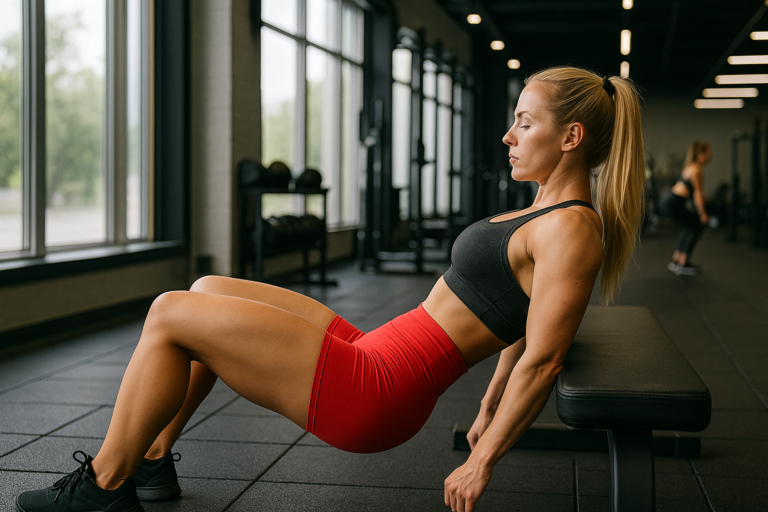
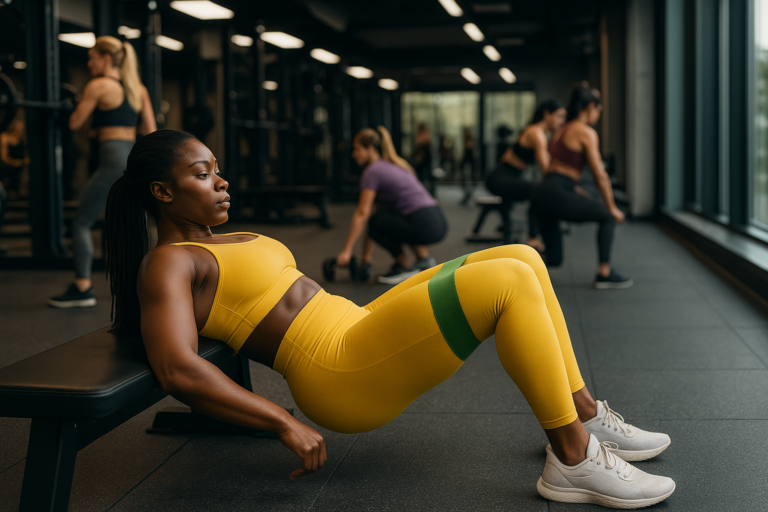
1. Hip Thrusts
The most powerful glute exercise.
How to do it:
- Sit with upper back on a bench or sofa
- Feet shoulder-width apart
- Drive hips upward
- Squeeze at the top for one second
- Lower slowly
Benefits:
- Builds projection and roundness
- Spares the knees
- Highly glute-dominant
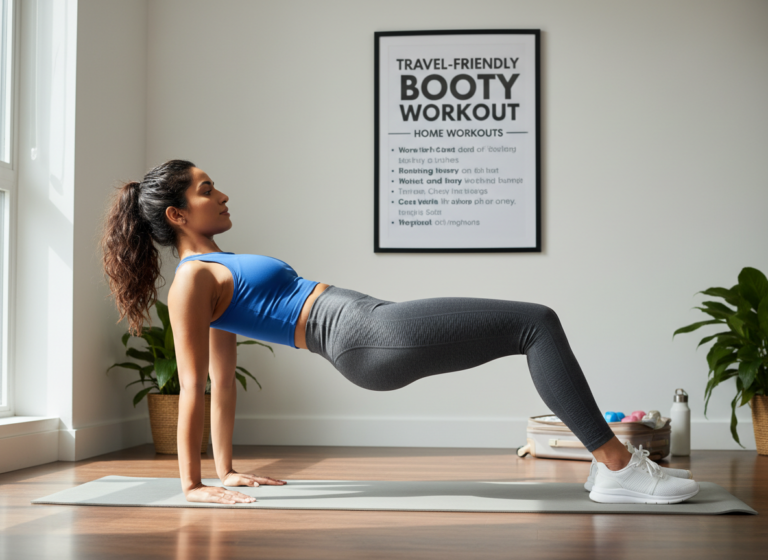
2. Glute Bridges
Perfect for beginners or home training.
Benefits:
- Strengthens glute maximus
- Easy to control
- High activation without heavy weight
Use single-leg variations for more intensity.
3. Frog Pumps
Feet together, knees open.
High-burn, high-activation exercise.
Benefits:
- Incredible glute pump
- Intensely isolates the glutes
- Great for shaping and rounding
4. Donkey Kicks
A classic for a reason.
Benefits:
- Isolates each glute
- Builds the under-glute curve
- Strengthens without loading the knees
Slow tempo works best.
5. Fire Hydrants
Targets the glute medius and minimus.
Benefits:
- Helps reduce hip dips
- Adds upper-glute shape
- Improves hip function
Using a resistance band increases challenge.
6. Banded Side Steps
Also called crab walks or lateral walks.
Benefits:
- Strengthens outer glutes
- Corrects knee alignment
- Prevents quad dominance
- A key exercise for women sitting long hours
Perfect warm-up or finisher.
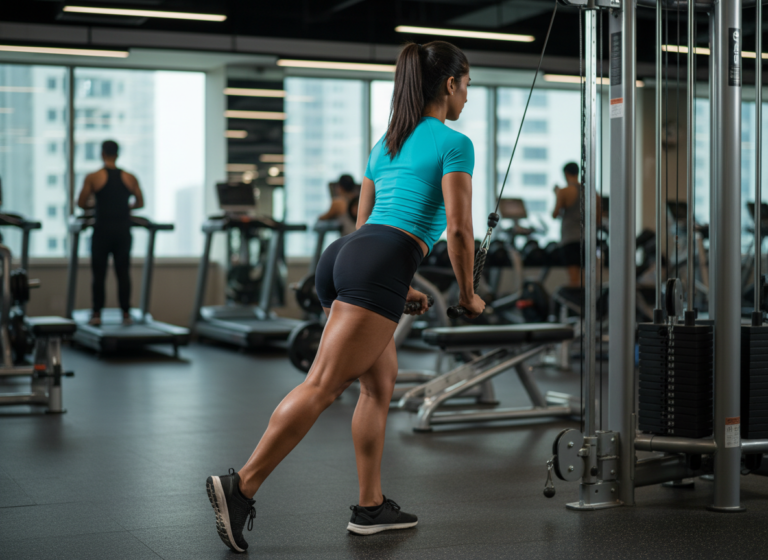
7. Standing Kickbacks
Works the glutes through hip extension without knee strain.
Benefits:
- Helps with projection
- Great mind-muscle connection
- Easy to perform anywhere
Keep abs engaged to stabilize the movement.
8. Glute Bridge March
Great for stability and building balanced strength.
Benefits:
- Challenges each glute individually
- Strengthens core and hips together
- Helps correct imbalance between left and right side
9. Single-Leg Hip Thrust
More intensity, more isolation, more shape.
Benefits:
- Superior glute growth
- Lowers risk of quad takeover
- Great for women with knee issues
A game-changer for symmetry.
10. Hip Hinge Leg Lift
Also known as a rear leg lift or straight-leg kickback.
Benefits:
- Targets lower glutes
- Defines the under-booty line
- Perfect alternative to deadlifts for home workouts
Slow, controlled movement gives best results.
Complete No-Squat, No-Lunge Booty Workout (20–30 Minutes)
Perform 2–3 times per week.
Section 1: Activation (3 minutes)
- 20 glute squeezes
- 20 banded abductions or standing abductions
- 20 donkey kick reps (10 per leg)
Section 2: Strength Block (The Shaping Phase)
Perform each exercise for 3 sets.
- Hip Thrusts
12–15 reps
Pause for 1 second at the top of every rep. - Single-Leg Glute Bridge
10 reps per side
Maintain slow control. - Hip Hinge Leg Lifts
12 reps per side
Focus on squeezing the lower glutes.
Section 3: Isolation Block (The Upper-Glute and Hip-Dip Fixer)
Perform 2–3 sets per exercise.
- Fire Hydrants
15 reps per side - Banded Side Steps
20 steps each direction - Standing Kickbacks
12–15 reps per side
These movements sculpt the outer glutes and round the shape from the top.
Section 4: Burnout Block (The Booty Pump)
Do these without rest for maximum burn.
- Frog Pumps
30 reps - Bridge Pulses
30 reps - Glute Bridge Hold
30 seconds
This finishing section increases metabolic stress, which supports hypertrophy even without heavy weight.
Progression Plan (How to Make This Routine More Effective Over Time)
If you repeat the same reps forever, the glutes will adapt and stop growing.
You need weekly progression.
Here are ways to make this workout more challenging:
Increase resistance
Use a thicker resistance band or add one if you currently train without one.
Increase reps gradually
Add 2–3 reps each week to one or two exercises.
Increase sets
Move from 2 sets to 3, or from 3 sets to 4, depending on the exercise.
Slow tempo
Increase time under tension by slowing the lowering phase to 3 seconds.
Add pauses
Hold the contraction at the top for 1–2 seconds during thrusts, bridges, or kickbacks.
These small increases create noticeable shape changes.
Common Mistakes While Training Without Squats
Avoid these to ensure fastest results:
- Using momentum instead of tension
- Allowing the lower back to arch during thrusts
- Not fully extending the hips
- Rushing reps
- Training too light with bands that offer no challenge
- Skipping warm-up activation
- Not squeezing the glutes intentionally
- Training only one angle (not enough variety)
The glutes need tension and variety, not heavy loads.
How Often Should You Do a No-Squat Booty Workout?
For visible shape changes:
- Beginners: 2 days per week
- Intermediate: 3 days per week
- Advanced: 3–4 days per week
Avoid training the glutes heavily on consecutive days.
A rest day improves contraction quality and strength.
Expected Results in 4–12 Weeks
Within 2 weeks:
Better glute activation and less thigh dominance.
Within 4–6 weeks:
More firmness, better posture, improved hip stability.
Within 8–12 weeks:
Visible shape change, rounder upper glutes, lifted side profile, reduced hip dip appearance.
You do not need squats or lunges to see these results.
You need consistency, the right angles, smart progression, and quality form.
Final Thoughts: Squats Are Optional, Booty Growth Is Not
Squats and lunges can be great exercises, but they are not essential for building feminine glute shape.
Many women see faster progress without them, especially if they struggle with quad dominance or knee discomfort.
A targeted no-squat, no-lunge program allows you to:
- isolate the glutes
- reduce stress on knees
- prevent thigh overgrowth
- build confidence
- improve shape from all angles
- train safely at home
This routine is not a shortcut.
It is a smarter path for the body types and lifestyles that need a more glute-focused, knee-friendly, realistic approach to booty training.
Your glute journey does not depend on heavy weights or complicated movements.
It depends on training the right muscles, with the right angles, consistently.
And now, you have the blueprint.