Social Media vs Reality: Booty Filters & Truth
Open any social media platform today—Instagram, TikTok, YouTube Shorts, Snapchat—and you’re flooded with an endless stream of “perfect” booties.
Round. High. Smooth. Symmetrical. Zero cellulite. Zero hip dips. Zero texture.
A waist so small it looks drawn. A booty so lifted it defies gravity.
The problem is not admiration. The problem is comparison.
For millions of women, social media has distorted what a “real” body, and specifically a real booty, actually looks like. Curves are edited. Angles are exaggerated. Shadows are sculpted. And filters? They’re doing more than smoothing skin—they’re reshaping bodies entirely.
This article breaks down:
- why social media booty images are unreliable
- how filters, angles, and poses distort reality
- what natural booties actually look like
- how this constant comparison affects confidence
- how to reclaim your mindset while still enjoying your fitness goals
- how to view your own progress without distortion
Let’s talk honestly—because your mental health and your relationship with your body matter more than “looking perfect” online.
The Rise of the “Perfect Booty” Online
Before social media, few people saw hundreds of bodies every day. You saw yourself, your friends, and maybe fitness models in magazines. Today, your brain is exposed to thousands of edited images per week.
These images create an illusion of what the “standard” booty is supposed to look like.
But this standard is:
- digitally enhanced
- surgically influenced
- posed perfectly
- lit professionally
- selected from hundreds of takes
What you’re comparing yourself to isn’t a person—it’s a production.
How Filters Distort the Booty: The Hidden Tricks
Filters have evolved far beyond smoothing skin or brightening colors.
Modern filters can:
- enlarge the booty
- shrink the waist
- remove indentations/hop dips
- lift the glutes
- add curves on the outer booty
- round the lower glute
- soften cellulite
- erase skin folds
- alter proportions seamlessly
These modifications aren’t always obvious. That’s the danger.
Your brain sees the image and thinks:
“This is what women actually look like.”
But it’s not.
What you’re seeing is a version of reality created by:
- AI reshaping
- retouching apps
- photo warping tools
- face and body smoothing filters
- lighting effects that highlight curves
Even professional fitness models edit photos. Even influencers with millions of followers use reshaping apps.
Comparing your real, lived body to someone’s polished, edited, curated highlight reel is not just unfair—it’s psychologically harmful.
The Angle Game: How Posing Can Change Everything
Angles can completely change how the booty looks.
Take the same woman and photograph her:
- facing the camera
- turning 45 degrees
- arching the lower back
- pushing one hip outward
- stepping one leg slightly back
- using overhead lighting
- tightening the glutes while posing
Her body will look dramatically different in every shot.
A natural booty becomes:
- rounder
- lifted
- fuller
- smoother
- more symmetrical
Now add a strategic mirror angle and good lighting, and the transformation becomes even more dramatic.
In real life, no one walks around with:
- perfect lighting
- arched posture
- glutes squeezed
- hips angled strategically
- filters smoothing muscle shadows
Booty photos are not real bodies. They’re staged moments.
The Outfit Trick: Clothing That Changes Proportions
Fitness influencers often wear:
- scrunch leggings that separate the glutes
- contour leggings with built-in shading
- V-seam leggings that lift the booty
- high-waisted designs that shrink the waist
- padded leggings or shorts
- compression materials that sculpt curves
These designs enhance:
- booty projection
- roundness
- lower-glute fold
- side curves
- hourglass shape
When you see a “perfect booty” online, remember: much of what you’re seeing is fabric engineering, not anatomy.
Editing Apps: The Quiet Industry Shaping Body Image
Apps like Facetune, Lightroom, Perfect365, and newer AI-powered editors allow for:
- reshaping curves
- increasing roundness
- lifting the glutes
- reducing hips or enlarging them
- adding shadow for fake muscle tone
- smoothing cellulite
- tightening skin
- narrowing waistlines
- adding a “shelf” to the booty
Influencers do it. Models do it. Everyday users do it.
The troubling part?
The edits are subtle enough that you believe they’re real.
You end up holding your natural, unedited body to someone’s improved, polished, filtered, curated version of themselves.
This is not self-comparison.
It is fantasy vs reality.
What Real Booties Actually Look Like
Not the filtered version.
Not the edited version.
Not the posing version.
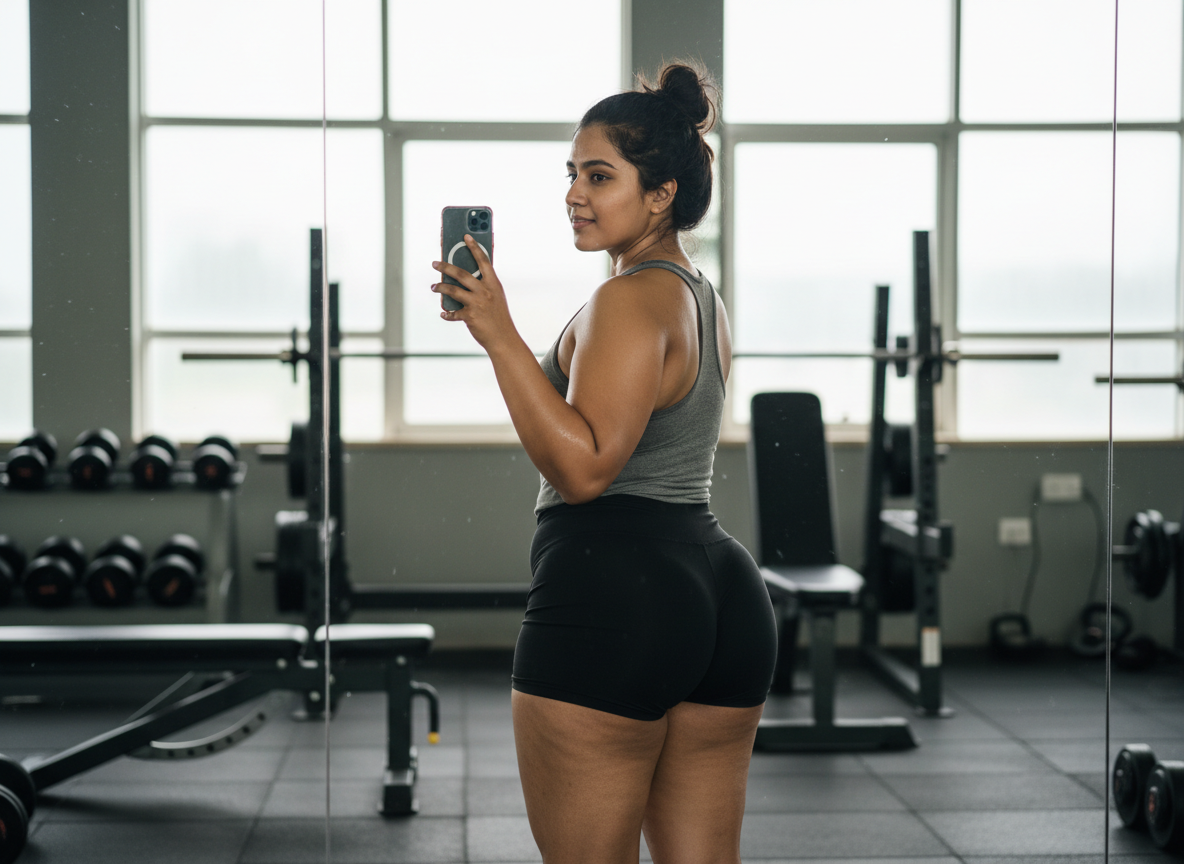
Real booties have:
- hip dips
- cellulite
- different shapes when flexed vs relaxed
- softness when sitting
- natural folds
- small asymmetries
- different fullness depending on fat distribution
- variations based on posture, lighting, or hormones
A real booty isn’t perfectly round from all angles.
Real glutes have texture because they are living muscles and tissues, not plastic surfaces.
Even strong, trained booties:
- look different in the morning vs evening
- change before and after a workout
- change during hormonal cycles
- flatten slightly in leggings
- lift when flexed and relax when neutral
- develop shape gradually over time
Comparing your real body to someone’s edited highlight image is not just unhelpful—it’s inaccurate.
How Social Media Impacts Your Confidence
Constant exposure to perfect images can create:
- body dysmorphia
- unrealistic expectations
- pressure to train harder than necessary
- obsession with flaws
- reduced self-esteem
- comparison anxiety
- feelings of inadequacy
It can also diminish your motivation because you feel like real progress is never enough.
The truth:
Your real body is already beautiful, functional, and capable.
What you need is perspective—not perfection.
How to Protect Your Confidence While Using Social Media
Here are practical strategies to keep your mindset healthy.
1. Curate Your Social Media Feed Intentionally
Follow accounts that show:
- real bodies
- authentic progress
- educational content
- realistic expectations
- inclusive fitness
Unfollow accounts that trigger:
- insecurity
- comparison
- negative self-talk
Your feed shapes your self-image.
2. Remember That Poses Are Not Real Life
A single posed glimpse of someone’s body does not reflect:
- how they sit
- how they look relaxed
- how they look first thing in the morning
- how they look in unflattering lighting
Your body isn’t meant to be a sculpture frozen in a flattering pose at all times.
3. Focus on What Your Body Can Do, Not Just How It Looks
Your glutes are powerful muscles, not decorations.
Shift your focus to:
- strength
- mobility
- energy
- posture
- performance
A body you appreciate becomes a body you take care of.
4. Never Compare Your Day 1 to Someone’s Year 10
Progress takes time, consistency, and patience.
Most influencers have been training:
- for years
- with professional guidance
- with access to gyms, photographers, and editors
- with sponsorship pressure to look a certain way
You’re on your own journey, at your own pace.
5. Accept That Imperfection Is Natural
Perfect symmetry does not exist.
Perfect roundness does not exist.
Zero cellulite does not exist.
Zero hip dips does not exist.
What does exist:
- your body
- your potential
- your progress
- your confidence
These matter more than digital illusions.
How to Track Booty Progress Without Social Media Tricks
Forget filters and angles. Instead use:
1. Strength Measurements
Track:
- hip thrust strength
- RDL progression
- squat depth
- stability improvements
Stronger glutes = growing glutes.
2. Fit of Your Clothing
You’ll notice:
- leggings feel tighter in the right places
- jeans hug differently
- curves feel more pronounced
This is real-world progress.
3. Consistent Lighting Photos
Use:
- same pose
- same lighting
- same time of day
This eliminates distortion and shows honest transformation.
4. How You Feel
Confidence comes before visible results.
If you feel:
- stronger
- more powerful
- more stable
- more grounded
You are improving.
Rebuilding Your Relationship With Your Body
Here are the mindset shifts that bring lasting confidence.
Your Body Is Not a Project to Fix
You don’t train because your body is wrong.
You train because you deserve strength, health, and confidence.
Fitness Is Not Punishment
It is empowerment.
A celebration of what your body can do.
A long-term investment in wellbeing.
Progress Is Not Linear
Some weeks you see change.
Some weeks you don’t.
Your glutes are growing even when you can’t see it.
You Can Love Your Body While Wanting to Improve It
Self-love and self-improvement are not opposites.
They are partners.
Final Thoughts: The Truth Behind Social Media Bodies
The majority of booties you see online are crafted by:
- angles
- lighting
- filters
- posing
- editing
- clothing design
- professional equipment
- years of selective posting
Your real booty is not supposed to look like that.
Your real booty is not a flaw.
Your real booty is allowed to be:
- imperfect
- strong
- soft
- changing
- growing
- unique
Real bodies are not edited bodies.
And the most beautiful thing you can build—alongside your glutes—is confidence rooted in truth, not comparison.
Honor your body.
Train it with love.
Shape it with patience.
And never forget:
Reality is enough.