Foam Rolling & Stretching for Sore Glutes
Sore glutes are one of the clearest signs that your workouts are working. But soreness that lingers too long, limits movement, or makes sitting uncomfortable can slow your progress and reduce the intensity of your next sessions. If you truly want rounder, stronger, better-shaped glutes, recovery is not optional. It is part of the training.
Foam rolling and stretching are two of the most powerful recovery tools for women who train glutes consistently. They reduce soreness, improve blood flow, enhance range of motion, reduce tightness, and ensure your glute muscles can activate properly during workouts.
This guide breaks down exactly why foam rolling works, which stretches matter most, how to do them safely, and how to build a full glute-recovery routine in just 10–15 minutes per day.
Let’s begin.
Why Your Glutes Get Sore in the First Place
Glute soreness usually comes from three training factors:
- New exercises that challenge the muscle in unfamiliar ways
- High-volume workouts with lots of reps, sets, or pump movements
- Loaded stretch exercises such as RDLs, hip thrusts, split squats, or bridges
When your glute fibers are stressed, small micro-tears form. As they repair, they grow stronger and fuller — which is how your booty transforms.
However:
- Too much tightness
- Poor mobility
- Poor recovery
- Insufficient stretching
can cause your glutes to become stiff, reduce activation, and increase compensations from your lower back or quads.
Foam rolling and stretching fix that.
Benefits of Foam Rolling for Glute Recovery
Foam rolling is a form of self-myofascial release. It targets the connective tissues around your muscles, releasing tension and increasing circulation.
Here’s what rolling the glutes actually does:
1. Breaks Up Muscle Tightness
Deep tissue tension restricts how well your glutes engage. Rolling loosens the tissue so your muscles fire more effectively.
2. Improves Blood Flow
More blood flow = more oxygen = faster repair and reduced soreness.
3. Reduces Delayed Onset Muscle Soreness (DOMS)
Regular rolling can reduce intensity and duration of soreness after lower-body days.
4. Restores Range of Motion
Tight glutes reduce hip mobility. Rolling improves flexibility and movement quality.
5. Helps Prevent Injuries
By reducing tension in glutes, piriformis, and outer hips, rolling protects your spine, knees, and hips during exercise.
How to Foam Roll the Glutes Properly
Foam rolling is not simply sitting on a roller and sliding around. The effectiveness comes from angles, pressure, and controlled breathing.
Below are the best ways to roll each area of the glutes.
Foam Rolling Technique 1: Gluteus Maximus Release
This targets the biggest part of your booty.
How to Do It:
- Sit on the foam roller with one foot crossed over the opposite knee.
- Lean slightly toward the crossed-leg side.
- Slowly roll from the top of the glute to just above the hamstring.
- When you find a tender point, pause and breathe for 10–20 seconds.
Why It Works:
Releases deep tissue tension that causes stiffness and soreness after heavy hip thrusts, RDLs, and bridge variations.
Foam Rolling Technique 2: Gluteus Medius / Upper Glutes
Located at the upper-outer booty, this area tightens easily from abductions, step-ups, curtsy lunges, and side-glute work.
How to Do It:
- Sit on the roller and shift to the side.
- Roll diagonally from the top of the hip crest to mid-glute.
- Keep movements slow and controlled.
Why It Works:
Releases the muscle that contributes to upper-glute roundness.
Foam Rolling Technique 3: Piriformis Release
A tight piriformis can cause glute soreness, hip tightness, and even sciatic-like discomfort.
How to Do It:
- Sit on the foam roller.
- Cross one ankle over the opposite knee.
- Lean into the glute of the crossed leg.
- Roll gently in small motions.
- Pause on tender spots.
Why It Works:
This small muscle can compress nerves when tight. Rolling it restores balance in the glutes and reduces radiating pain.
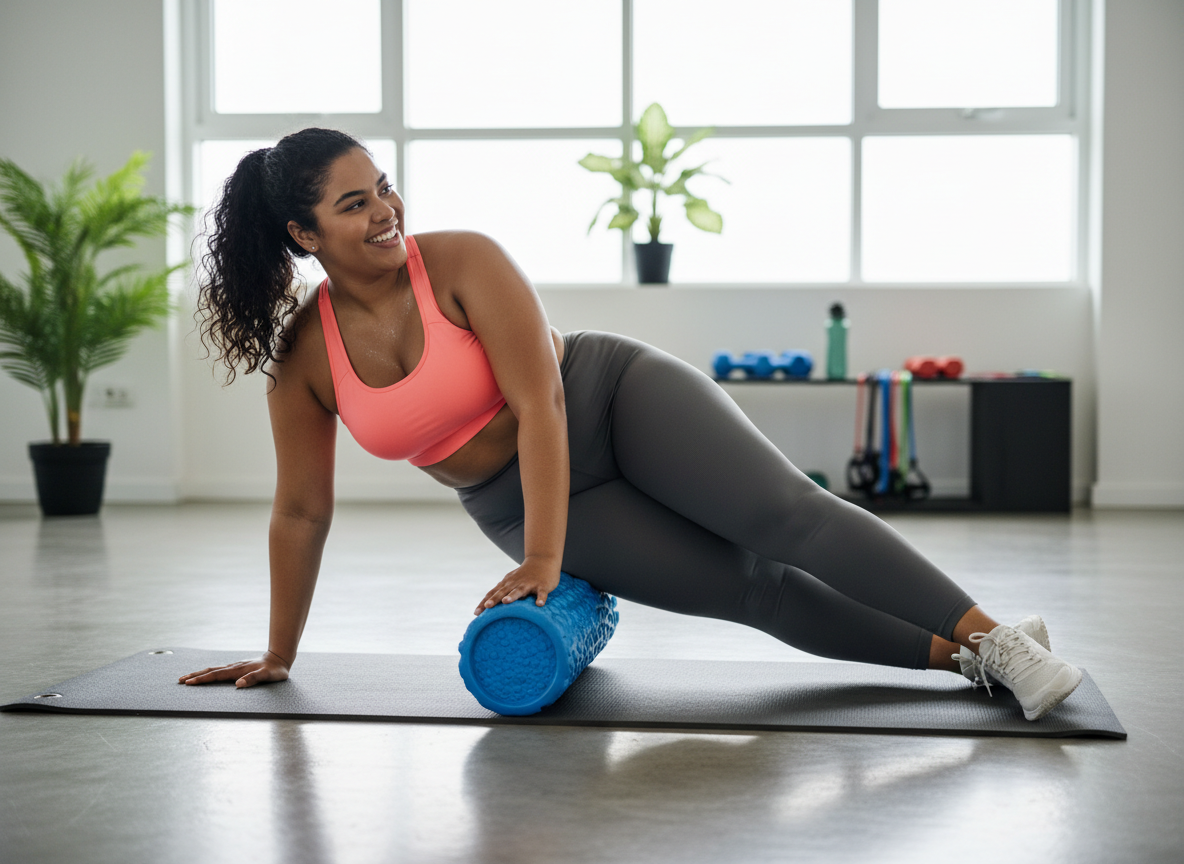
Foam Rolling Technique 4: IT Band / Side Hip Release
Although the IT band itself is not a muscle, the tissues around it benefit from rolling.
How to Do It:
- Lie sideways on the foam roller.
- Support your upper body with your hands and forearms.
- Roll the upper portion near the hip, not the entire length.
Why It Works:
Relieves lateral tightness that pulls on the glutes and affects booty shape.
How Long Should You Foam Roll?
For best results:
- 30–60 seconds per glute area
- 2–4 minutes total per side
- 2–6 times per week depending on soreness and training frequency
Rolling should feel slightly uncomfortable, but not painful.
Too much pressure can backfire — aim for moderate intensity.
Stretching for Glute Recovery: Why It Matters
Foam rolling loosens the muscle and the fascia. Stretching then lengthens the muscle fibers, restoring mobility and promoting recovery.
Stretching helps:
- reduce tightness
- improve posture
- allow deeper hip hinge movements
- support better booty activation
- prevent quad takeover
- reduce lower-back compensation
- maintain symmetry and muscle balance
Below are the best glute stretches for women who lift.
Stretch 1: Seated Figure-Four Stretch
Targets the gluteus maximus, medius, and piriformis.
How to Do It:
- Sit upright with legs extended.
- Cross one ankle over the opposite thigh.
- Lean forward gently.
- Hold 30–45 seconds.
Why It’s Effective:
Releases deep glute tightness that builds up from thrusts, lunges, and squats.
Stretch 2: Pigeon Pose (Glute Deep Stretch)
This is one of the most powerful glute stretches.
How to Do It:
- Start on hands and knees.
- Bring one knee forward and place it behind your wrist.
- Extend the opposite leg straight back.
- Lean forward into the stretch.
Why It’s Effective:
Targets glutes, hip rotators, and outer glute structures deeply.
Stretch 3: Standing Glute Stretch
Great for beginner flexibility and post-workout cool down.
How to Do It:
- Stand and cross one ankle over the other knee.
- Sit back into a mini-squat.
- Hold onto a wall or chair if needed.
Why It Works:
Lengthens glutes while improving balance and hip mobility.
Stretch 4: Lying Glute Crossover Stretch
Opens the lower back and glutes together.
How to Do It:
- Lie on your back.
- Bring one knee across your body.
- Keep shoulders flat on the ground.
Why It Works:
Reduces tension after heavy hip-hinge days like RDLs or split squats.
Stretch 5: Kneeling Hip Flexor Stretch (Indirect but Essential)
Tight hip flexors reduce glute activation.
How to Do It:
- Kneel with one foot forward.
- Shift hips forward gently.
- Keep torso upright.
- Hold 20–30 seconds per side.
Why It Works:
When hip flexors release, glutes can contract fully, improving both shape and recovery.
How to Combine Foam Rolling and Stretching Effectively
Below is an ideal post-workout recovery routine.
Phase 1: Foam Roll (5–8 minutes)
- Glute Max — 1 min
- Glute Medius — 1 min
- Piriformis — 1 min
- Side Hip/IT Band — 1 min
Repeat for the opposite side.
Phase 2: Static Stretching (5–8 minutes)
- Figure-Four Stretch — 30 sec each side
- Pigeon Stretch — 30 sec each side
- Standing Glute Stretch — 30 sec each side
- Hip Flexor Stretch — 30 sec each side
This routine restores balance, reduces soreness, and enhances long-term performance.
When to Foam Roll and Stretch
Here’s the best timing:
Before Workouts (Quick Version)
- 30 seconds glute rolling
- 10–20 seconds dynamic stretch
- 1–2 activation exercises
This improves movement quality and booty activation.
After Workouts
- Full foam rolling
- Deep static stretches
This reduces soreness and supports growth.
On Rest Days
- Full routine
- Light mobility
- Walking or gentle movement
Avoid complete inactivity if soreness is high. Movement promotes healing.
Signs You Need More Rolling and Stretching
You may need 10–15 minutes of glute mobility if you notice:
- lower-back pain after booty workouts
- quads taking over exercises
- hip tightness
- limited depth in squats or hip thrusts
- clicking or stiffness in hips
- poor glute activation
- soreness lasting more than 72 hours
These are all signs the muscle is tight, fatigued, or inflamed — and recovery work will restore balance.
Mistakes to Avoid with Foam Rolling and Stretching
1. Rolling too fast
The slower the roll, the better the release.
2. Using too much pressure
Pain causes muscles to tighten more, not release.
3. Stretching cold muscles too deeply
Warm up slightly before attempting deep stretches.
4. Holding your breath
Breathing relaxes the muscle and nervous system.
5. Ignoring the hip flexors
Releasing them improves glute activation dramatically.
Optional Tools That Enhance Glute Recovery
You do not need expensive equipment.
These basic tools help significantly:
- foam roller (soft or medium density)
- massage ball or lacrosse ball
- resistance band for mobility
- stretching strap
- yoga mat
Each item helps target tension and improve flexibility in different ways.
A Complete 10–15 Minute Glute Recovery Routine
Use this two to three times per week.
It improves soreness, mobility, and shape development.
1. Foam Roll Glute Max — 1 minute per side
2. Foam Roll Glute Medius — 1 minute per side
3. Foam Roll Piriformis — 1 minute per side
4. Figure-Four Stretch — 30 seconds per side
5. Pigeon Pose — 30–45 seconds per side
6. Standing Glute Stretch — 30 seconds per side
7. Hip Flexor Stretch — 30 seconds per side
This routine is equally important as your workout itself.
Final Thoughts: Recovery Is Part of the Booty-Building Process
You cannot build a rounded, lifted, strong booty without proper recovery.
Foam rolling and stretching are not “extras” — they are essential.
They help you:
- move better
- activate better
- lift heavier
- feel less stiff
- prevent injury
- grow consistently
The glutes respond best when they are both strong and mobile.
The more you maintain them with intentional recovery, the faster they grow.
A well-trained glute is a well-recovered glute.