From Shame to Strength: Transforming Butt Insecurities
Every woman has a story about her body—how she has viewed it, shaped it, hidden it, flaunted it, compared it, blamed it, or learned to love it.
And among all the body parts we judge most harshly, the butt often ranks at the top.
Too flat.
Too big.
Too small.
Too saggy.
Too square.
Too jiggly.
Too soft.
Not round enough.
Not lifted enough.
Not looking like the current social media standard.
The truth is simple:
Your butt has never been the problem.
The problem is the story you’ve been told about it.
This article is not about exercises (you already have plenty).
It’s about the emotional weight many women carry in silence.
It’s about walking the journey from hiding your booty to owning it fully—because confidence isn’t built from changing your glutes alone.
It’s built from changing the meaning you attach to them.
Let’s break down how butt insecurities are formed, why they feel so heavy, and how you can move from shame to strength with both mindset shifts and practical action.
Why Butt Insecurities Run So Deep
Women are taught from a young age that their worth is tied to how their bodies look—especially how their lower body looks.
Fashion trends change.
Social standards shift.
But the pressure remains constant.
Here’s why glute insecurities hit harder than most:
1. Your butt is tied to femininity in culture
Across cultures, the female silhouette is symbolized by curves.
When a woman doesn’t match the “ideal” shape of the moment, she often feels less feminine or less desirable—even though these standards are entirely invented.
2. Social media intensifies comparison
Filters, posing angles, and editing apps create unrealistic glute shapes that don’t exist in daily life.
Women compare themselves to digital illusions.
3. Clothing trends highlight the lower body
Leggings, high-waisted jeans, bodycon dresses—these modern styles emphasize the booty.
If you’re insecure, these trends feel more like pressure than fashion.
4. Many women carry childhood or teenage comments
A single hurtful sentence—“you have no butt,” “your butt is too big,” “your hips are weird”—can stay with someone for decades.
Shame often begins early.
5. The butt physically changes with age, stress, and lifestyle
Unlike facial features, your glutes respond dramatically to movement patterns, sitting time, hormones, and strength levels.
This means insecurity can become tied to a feeling of “losing control.”
But here’s what matters most:
Glute insecurities do not reflect your worth—they reflect conditioning, comparison, and misunderstanding.
Let’s rewrite that story.
Understanding Shame: What It Really Is
Shame is not about what your body looks like.
Shame is about feeling unworthy because of it.
Shame says:
“I don’t like how my butt looks, and therefore something is wrong with me.”
Confidence says:
“My butt looks how it looks today, and that says nothing about my value.”
Shame thrives in silence.
Strength thrives in ownership.
Let’s walk the path toward ownership.
The Shift From Shame to Strength Begins With Three Mindset Changes
These three internal rewrites change more than any exercise ever could.
Mindset Shift 1: Your Butt Is Not Meant to Look Like Anyone Else’s
Your glute shape is influenced by:
- pelvis width
- muscle insertion points
- bone structure
- genetics
- lifestyle
- age
- training history
These factors make your booty unique, not flawed.
Two women can do the exact same workout and develop completely different shapes.
Why?
Because the goal isn’t to become someone else.
It’s to become your strongest, healthiest, most confident self.
Mindset Shift 2: Your Butt Is a Functional Powerhouse, Not Just a Body Part
Your glutes:
- stabilize your spine
- protect your knees
- support your posture
- enhance athletic ability
- improve balance
- increase metabolic health
- prevent lower-back issues
Your booty is an engine, not an ornament.
Training it for strength inevitably elevates its appearance—but more importantly, it elevates your entire life.
Mindset Shift 3: You Can Improve Shape Without Hating Yourself
You can love yourself and still want change.
You can appreciate your body and still want growth.
You don’t have to choose between self-acceptance and self-improvement.
This is one of the most empowering realizations for women beginning their fitness journeys.
Improvement becomes joyful when it’s no longer driven by:
- shame
- self-criticism
- comparison
And instead driven by:
- curiosity
- empowerment
- pride
- self-respect
Where Butt Insecurities Come From (And How to Break Free)
Let’s walk through the five most common sources of glute insecurity and the antidotes to each.
1. Fear of Judgment at the Gym
Women often feel watched, even when no one is paying attention.
The fear of people judging your form, your outfit, or your body shape can be paralyzing.
The Strength Shift:
Most people are so focused on themselves that they barely notice others.
But more importantly:
Confidence grows from action, not absence of fear.
Every time you train your glutes, regardless of who’s there, you reclaim ownership of your body.
2. Comparing Your Progress to Others
Everyone grows at a different pace.
Your booty journey is influenced by:
- your starting point
- your muscle engagement
- your training frequency
- your nutrition
- your recovery
Comparison destroys motivation.
The Strength Shift:
Measure progress by:
- strength increases
- better activation
- better posture
- consistency
Physical change always follows inner change.
3. Feeling Behind Because of Social Media
Most glute images online are edited, enhanced, posed, filtered, or surgically altered.
You are comparing your real body to someone else’s highlight reel.
The Strength Shift:
Real bodies change gradually.
Real growth takes time.
Real curves come from consistency, not perfection.
Unfollow accounts that trigger insecurity.
Follow accounts that inspire strength and education.
4. Negative self-talk
Many women critique themselves harsher than anyone else ever would.
“I hate how I look.”
“Why can’t I look like her?”
“My butt is hopeless.”
These statements are not facts.
They are habits.
The Strength Shift:
Replace criticism with neutral observation.
Instead of:
“My butt looks terrible,”
Try:
“My glutes feel weaker today, and I’m working on strengthening them.”
Shift from judgment to curiosity.
5. Allowing the Butt to Define Your Beauty
Your beauty is multidimensional.
Your butt is just one feature among dozens that make you unique.
Your compassion is beautiful.
Your intelligence is beautiful.
Your energy is beautiful.
Your resilience is beautiful.
Your booty?
It’s just one part of the story.
The Strength Shift:
Your identity is larger than any body part.
Practical Steps to Transform Insecurity Into Strength
Mindset alone won’t solve everything—action reinforces confidence.
Here’s how to build emotional and physical strength side by side.
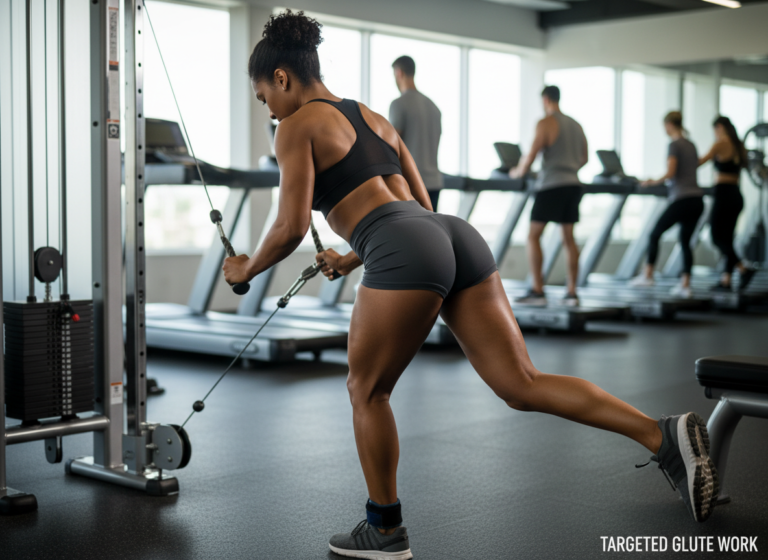
Step 1: Start With Low-Pressure Glute Activation You Can Do at Home
Simple movements like:
- bridges
- abductions
- kickbacks
- clamshells
These are approachable, private, and empowering.
You don’t need a gym to begin confidence.
Step 2: Train for Strength—not punishment
Strength training does not just change your body.
It changes your identity.
You start seeing your butt as powerful instead of flawed.
Lift to get stronger.
Lift to move better.
Lift to feel capable.
A stronger woman becomes a more confident woman.
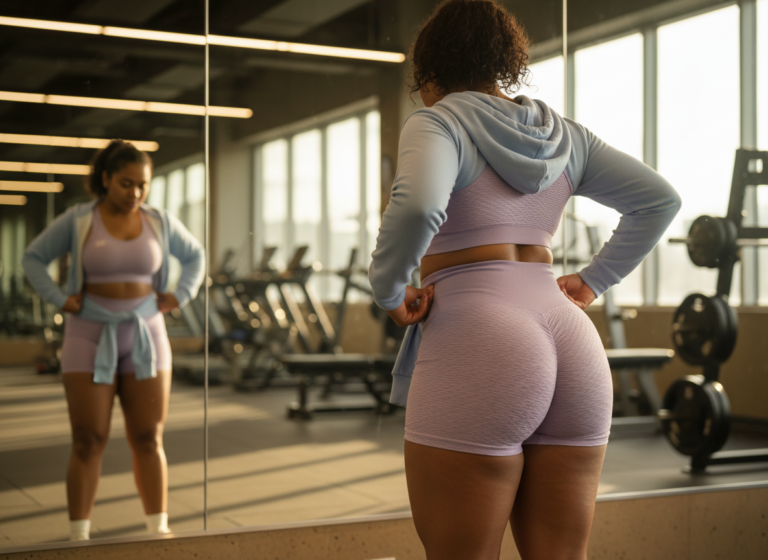
Step 3: Wear Clothing That Supports (Not Hides) You
You don’t have to force yourself into revealing leggings.
But wearing clothes that fit, flatter, and feel comfortable helps you reconnect with your body without avoidance.
You deserve to feel good in your own skin today—not only after transformation.
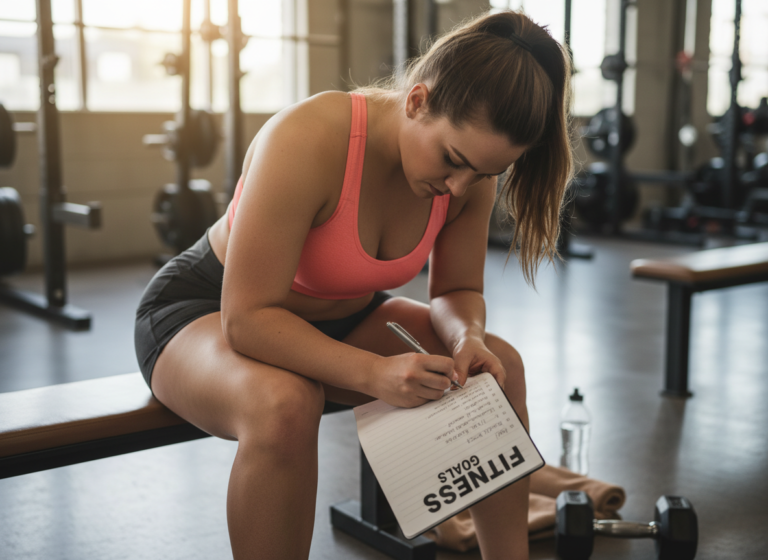
Step 4: Track Strength Progress, Not Scale Numbers
The booty journey is not about weight loss.
It’s about:
- better glute activation
- increasing reps
- improving form
- adding load or tempo
Body changes follow functional improvements.
Your glutes grow when your confidence does.
Step 5: Celebrate What Your Glutes Do for You
Your butt is not just shape—it is strength.
It helps you:
- stand
- walk
- lift
- climb stairs
- balance
- run
- dance
Gratitude turns insecurity into appreciation.
Step 6: Normalize Slow Progress
Real glute transformation takes:
- 4 weeks to feel
- 8 weeks to see
- 12+ weeks for others to notice
Slow does not mean ineffective.
Slow means sustainable.
Step 7: Build a Positive Environment
Surround yourself with:
- people who uplift you
- creators who educate, not pressure
- workouts that empower, not shame
- clothing that supports your shape
Confidence grows when your environment isn’t working against you.
What Confidence REALLY Looks Like In This Journey
Confidence is not:
- having the biggest booty
- having the most sculpted glutes
- being booty-pose ready every day
- lifting the heaviest weights
- fitting a trend
Confidence is:
- showing up
- trying again
- training even when you’re unsure
- refusing to compare
- wearing what makes you comfortable
- choosing progress over perfection
- standing tall regardless of current shape
Confidence is built, not born.
Confidence is owned, not given.
Your Booty Is Allowed to Change—And So Are You
Your glutes will go through phases:
- strong
- tired
- growing
- plateauing
- reshaping
- resting
Your identity should not depend on any of these phases.
Your journey from shame to strength is not about your glutes.
It is about reclaiming power over the narrative you tell yourself.
Because when a woman stops apologizing for her body and starts honoring it, everything shifts.
She moves differently.
She speaks differently.
She trains differently.
She believes differently.
From that place, her booty transformation becomes not just physical—but emotional, mental, and lifelong.
And that is the true journey.